

Bot Telegram
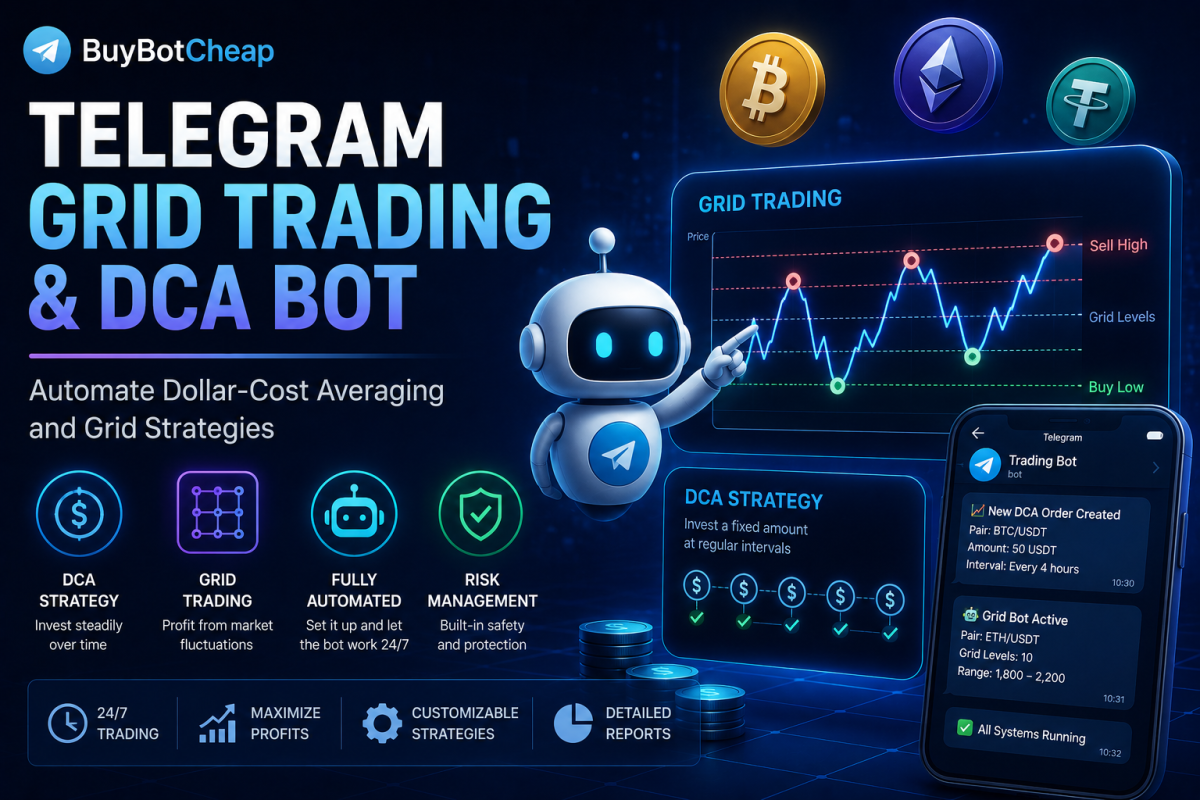
Telegram Grid Trading & DCA Bot: Automate Dollar-Cost Averaging and Grid Strategies 2026
Aug
Discover how a Telegram Grid Trading & DCA Bot automates dollar-cost averaging and quantitative grid orders on-chain directly inside Telegram. Maximize sideways market profits and accumulate crypto hands-free.
A Telegram Grid Trading & DCA Bot is an automated on-chain execution assistant embedded directly within Telegram’s messaging interface. It enables users to deploy quantitative trading strategies—such as systematic Dollar-Cost Averaging (DCA) and dynamic Range Grid Trading—without interacting with complex decentralized exchange (DEX) web portals or managing manual order placements.
By combining the convenience of chat commands and interactive inline buttons with automated smart-contract routing, traders can continuously accumulate assets or scalp sideways market volatility across multiple blockchains 24/7.
Core Quantitative Strategies Powered via Telegram
The bot executes two primary algorithmic frameworks tailored for volatile and ranging markets:
-
Automated Dollar-Cost Averaging (DCA): Executes recurring buy orders at preset time intervals (e.g., hourly, daily, weekly) or dynamic price-drop triggers (e.g., buy whenever the asset dips by 5%). This systematically lowers the average entry price and eliminates emotional market timing.
-
Autonomous Grid Trading: Deploys a ladder of buy and sell limit/swap orders within a user-defined price band (upper and lower bounds). Whenever the price drops to a lower grid line, the bot executes a buy; as the price rebounds to an upper grid line, it automatically triggers a sell to capture spread profit.
-
Trailing Grid & Martingale Modes: Automatically adjusts grid boundaries upward during strong bullish breakouts, or scales order sizing progressively during sharp dips to optimize break-even pricing.
-
Instant PnL & Portfolio Tracking: Delivers real-time Telegram notifications, visual chart updates, and push alerts whenever a grid level triggers or a DCA cycle completes.
Strategy Comparison: DCA vs. Grid Trading
| Strategy Feature | Dollar-Cost Averaging (DCA) | Grid Trading Bot |
| Market Condition | Long-term accumulation, bear/chop markets | Ranging, sideways, and oscillatory markets |
| Primary Goal | Minimize volatility & lower entry price | Extract frequent micro-profits from price swings |
| Order Execution | Time-based or percentage-dip triggers | Price-level geometric/arithmetic grid lines |
| Capital Allocation | Gradual deployment over scheduled periods | Distributed across multiple buy/sell tiers |
| User Intervention | Set-and-forget long-term configuration | Requires periodic boundary recalibration |
Essential Technical Features of a Telegram Bot
-
Non-Custodial & Encrypted Key Storage: Private keys are secured using client-side encryption (AES-256) or integrated with multi-party computation (MPC) wallets, ensuring user assets remain protected.
-
Interactive Inline UI: Intuitive Telegram buttons allow users to set upper/lower limits, adjust grid counts, set stop-loss levels, and monitor live PnL without typing manual syntax.
-
Gas-Optimized DEX Routing: Automatically routes swap transactions through DEX aggregators (e.g., Jupiter on Solana, 1inch on EVM) to find the deepest liquidity and lowest slippage.
-
Built-In Risk Guards: Features instant emergency liquidation buttons, automated take-profit thresholds, and strict stop-loss triggers that execute if an asset breaks below the lower grid boundary.
Practical Risk Management Rules
-
Define Clear Grid Boundaries: Avoid setting overly wide grids that dilute capital efficiency or overly tight grids where DEX swap fees consume the spread profits.
-
Account for Impermanent Volatility: In strong, one-directional downtrends, a grid bot will accumulate the base asset down to the lowest grid line. Always pair grid strategies with hard stop-losses to protect core capital.
Other:
- Multi-Chain Sniping Bot: Auto-Buy New Tokens on Solana, Base, and EVM at Liquidity Launch
- Pump.fun & SunPump Auto Buyer: Millisecond Memecoin Launchpad Sniping Bot
- Whale Copy-Trading Bot: Automate Swaps by Mirroring High-Win-Rate Smart Money Wallets
