

Bot Telegram
Limit Order Bot for DEXs: Automate Limit Buys and Sells on Uniswap & Raydium 2026
Aug
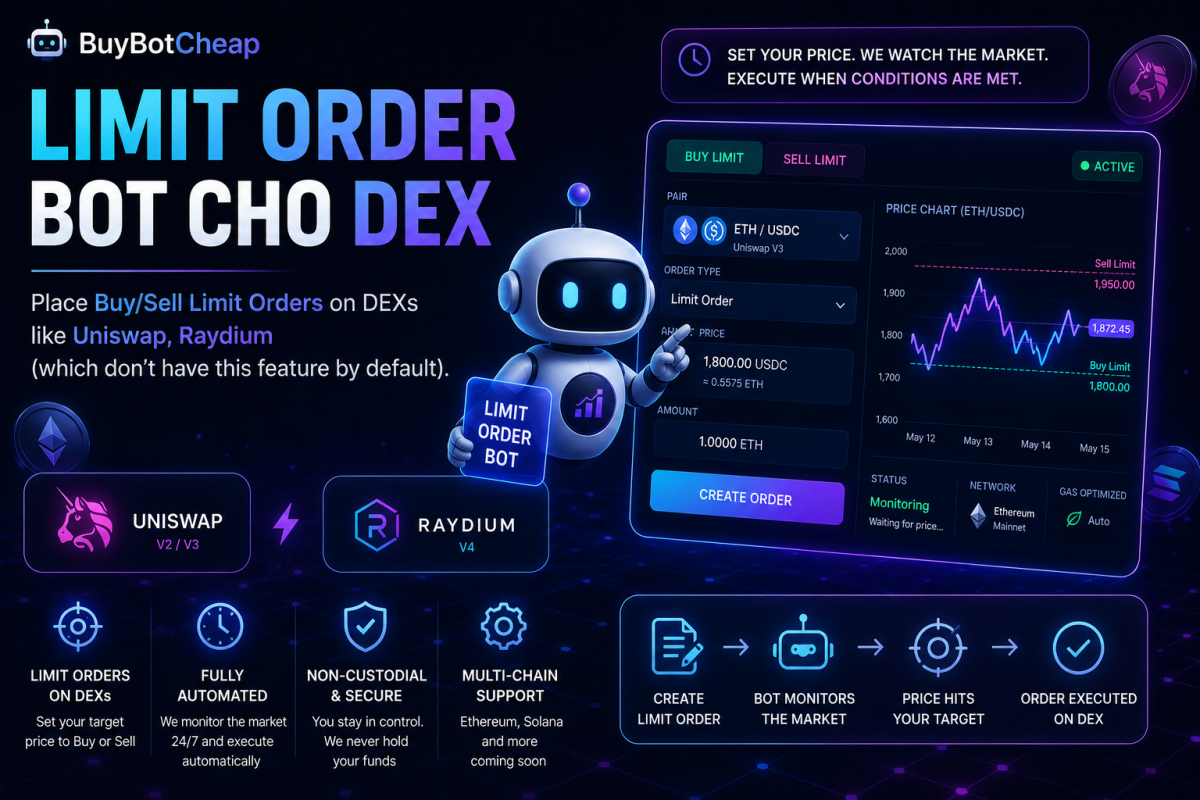
Unlock centralized exchange functionality on decentralized protocols. Discover how a DEX Limit Order Bot enables automated limit buys, stop-losses, and take-profit triggers on Uniswap, Raydium, and PancakeSwap without custody risk.
A DEX Limit Order Bot is an automated on-chain execution protocol designed to bring non-custodial, pre-set price order capabilities to decentralized exchanges (DEXs). Most Automated Market Maker (AMM) platforms—such as Uniswap v2/v3 on EVM networks and Raydium on Solana—natively support only instant swaps at current pool prices.
Without built-in order books, decentralized traders face constant chart-watching and missed entry or exit targets during volatile swings. A Limit Order Bot solves this structural liquidity problem by monitoring pool reserves, calculating exact target execution prices, and executing transactions on-chain only when pre-configured market conditions are satisfied.
How On-Chain Limit Orders Work on AMM DEXs
Because constant-product AMM contracts cannot store pending orders natively without high gas consumption, limit order bots utilize off-chain computation paired with on-chain settlement:
-
Off-Chain Price & State Monitoring: The bot monitors live AMM pool reserves through sub-second WebSocket or gRPC connections. It continuously computes the current token conversion ratio based on pool depth and circulating liquidity.
-
Order Storage & Cryptographic Signing: When a user sets a target limit price, the bot generates an EIP-712 permit message or Solana instruction. The user signs the intention without spending gas upfront or locking capital into an intermediate escrow contract.
-
Keeper & Relayer Execution Engine: A network of automated keepers checks whether the current AMM price matches or crosses the target order price. Once the threshold is reached, the keeper packages the order into a signed transaction and broadcasts it to the blockchain.
-
Settlement via Router Contracts: The transaction interacts with dedicated smart contracts (such as Uniswap routers or Raydium CPMM pools), swaps the token at the requested price or better, and deposits the output tokens directly into the user’s non-custodial wallet.
Comparison: DEX Limit Orders vs. Centralized Exchange (CEX) Orders
| Feature | DEX Limit Order Bot | Centralized Exchange (CEX) |
| Asset Custody | Non-custodial (funds stay in your private wallet) | Fully custodial (held on exchange balance) |
| Execution Environment | On-chain AMM pools & DEX aggregators | Internal off-chain central limit order book |
| Upfront Gas Cost | Free signature generation (Gas paid only on execution) | No gas fee (Platform trading fee deducted) |
| Slippage Control | Hard-capped maximum slippage protection | Direct order matching at book depth |
| KYC / Account Setup | Zero KYC (Connect wallet via Web3 or Telegram) | Mandatory KYC and regional restrictions |
| Token Availability | Instant access to any newly minted token/pool | Limited to vetted and listed trading pairs |
Essential Technical Features for DEX Limit Order Bots
-
Automated Take-Profit & Stop-Loss (TP/SL): Configure conditional multi-stage triggers that activate a stop-loss swap if price drops below support, or execute tiered take-profit orders as the token breaks upward resistance levels.
-
Anti-Sandwich / MEV-Resistant Execution: When keepers execute pending limit swaps, transactions are routed through private mempool channels (Flashbots, MEV-Blocker, Jito bundles) to ensure searchers cannot exploit the predictable transaction size.
-
Dynamic Gas Price Optimization: If network gas spikes during extreme market volatility, the bot automatically calculates whether the execution remains profitable after transaction fees before broadcasting.
-
Trailing Stop-Loss Orders: Dynamically adjusts the stop-loss trigger price upward as the market price climbs, locking in accrued gains while providing an automatic exit during abrupt trend reversals.
Key Risk Considerations and Best Practices
-
Low-Liquidity Price Gaps: On low-liquidity pairs, a single large sell order can skip straight past your limit price. Ensure your bot includes a flexible execution window or auto-market-fallout trigger.
-
Approval Security: Always manage token allowances carefully. Use exact-amount approvals rather than infinite approvals when granting spending permissions to intermediary limit-order settlement contracts.
Others:
- Multi-Chain Sniping Bot: Auto-Buy New Tokens on Solana, Base, and EVM at Liquidity Launch
- Pump.fun & SunPump Auto Buyer: Millisecond Memecoin Launchpad Sniping Bot
- Whale Copy-Trading Bot: Automate Swaps by Mirroring High-Win-Rate Smart Money Wallets
